
Here’s the honest answer: it depends. And that’s not a dodge.
It’s genuinely the most accurate thing anyone can tell you upfront.
Kitchen countertop installation costs vary dramatically based on the material you choose, how complex your layout is, what edge profile you want, and who does the work. That last one surprises people. Two kitchens the same size with the same material can land at very different numbers depending on every one of those variables.
But honestly? The number itself is almost useless without context.
The real cost of a countertop replacement isn’t just the material. It’s the edge profile you chose without realizing it costs extra. It’s the plumber nobody told you to budget for. It’s the demo fee buried at the bottom of the quote, or worse, not in the quote at all. Understanding what actually drives the number is what separates a budget that holds from one that blows up on installation day.
Kitchen countertop costs can vary a lot
and the material is only part of the equation. Layout complexity, edge profiles, cutouts, demolition, plumbing, and installation quality all impact the final price more than most homeowners expect.
The Number You Found Online Is Real. It’s Also Incomplete.
People come in with a countertop cost per square foot they found on Google. That number exists, it’s accurate enough, but it’s doing a lot of hiding. It doesn’t include cutouts for your sink and cooktop. Doesn’t include tearing out your old countertops. Doesn’t include the plumber who has to disconnect your sink before anyone can set a new slab.
What this guide does: breaks down the full picture. By material. By what quietly inflates your quote. By where you can legitimately trim and where trimming just defers pain.
Where Each Material Falls on the Cost Spectrum
Not all countertop materials are created equal and they don’t cost the same either. Here’s how the most common kitchen countertop options stack up, from most budget-friendly to most premium.
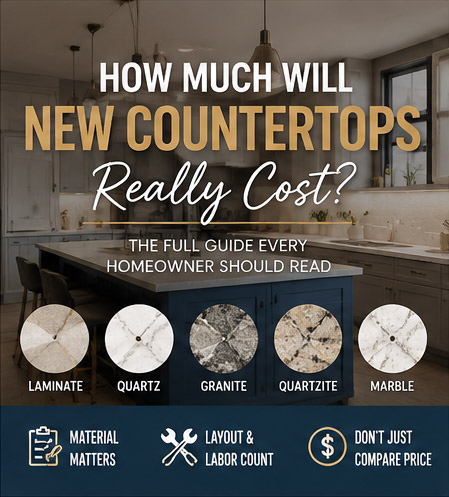
Laminate is the most budget-friendly option
quartz is the most popular for its low maintenance and durability, granite offers a timeless natural stone look with excellent longevity, quartzite delivers a high-end luxury feel with more maintenance, and marble is beautiful but requires the most care.
Laminate:
The Budget-Friendly Starting Point
Don’t roll your eyes. Laminate has genuinely earned a second look in the last decade. The printing technology caught up and you can now find laminate that mimics concrete, marble, and wood with actual surface texture, not just a printed image that fools nobody up close. Brands like Formica and Wilsonart have invested heavily in the category, and it shows.
It sits at the low end of the countertop cost spectrum, which makes it genuinely appealing for rentals, flips, or kitchens that just need to function while you save up for something else. Not a consolation prize. A practical choice with real limitations you need to go in understanding.
Those limitations matter. Laminate can’t take a hot pan, not even close. You’ll warp or scorch the surface and there’s no coming back from that. It scratches. Seams are visible if you’re looking for them. Once the surface is compromised, it’s compromised. You can’t sand it down and refinish it the way you might with wood.
For a serious cooking household where countertops see real daily use? Worth the conversation about whether the savings are actually worth the tradeoffs.
Quartz Countertops:
Mid-to-Premium, and Where Most People Land
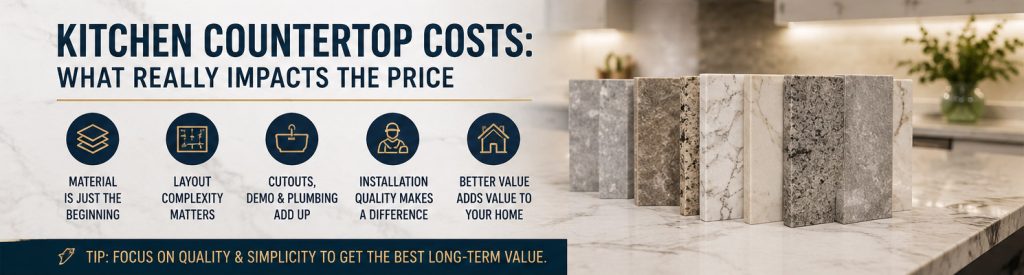
This is the sweet spot for most homeowners, and for good reason. Engineered quartz is made from ground quartz crystals suspended in resin and pigment. That gives you consistent color across the entire slab, zero sealing requirements, and resistance to the stains a kitchen actually produces. Grape juice, tomato sauce, coffee. Quartz handles all of it without complaint.
Quartz countertop costs vary more than people expect within the category itself. Entry-level quartz from a value brand and a premium Cambria or Caesarstone collection are technically both “quartz” but they are not remotely the same product. Slab thickness matters too. A thicker slab costs more, performs better, and looks more substantial on an island. Brand, pattern complexity, and your layout all move you up or down within the quartz range.
One thing that trips people up: quartz hates heat. Thermal shock can crack or permanently discolor it. This is the material’s one genuine weakness, and it’s a non-negotiable habit change. Trivets every time, no exceptions.
Granite Countertops:
Comparable to Quartz, With a High-End Ceiling That Goes Higher
Granite countertop costs and quartz costs run close to each other across most of the range, though quartz tends to sit a touch higher on average because of brand premiums and manufacturing consistency. But here’s where it gets interesting. At the high end, granite wins and it isn’t close. A dramatic slab with exotic veining, unusual coloration, or rare origins can command prices that dwarf anything in the quartz world. Natural stone has that going for it. No two slabs alike.
The maintenance story on granite is also better than most people think. Seal it once a year, which takes about twenty minutes, and you essentially have an indestructible surface. There are granite countertops in forty-year-old homes that still look extraordinary. People don’t give granite enough credit.
Quartzite:
Premium Natural Stone, and Not What You Think It Is
Stop. Before we go further: quartzite is not quartz. They share part of a name and that’s where the overlap ends. Quartzite is a natural metamorphic stone pulled from the earth, harder than granite, fully porous, and absolutely stunning. Quartz is an engineered product made in a factory.
This confusion causes real problems. Customers who think they’re getting low-maintenance engineered quartz sometimes walk away with quartzite, which needs sealing, can etch when it meets acidic substances, and behaves like natural stone in every way, because it is natural stone. Always ask to see the product spec sheet. This is not a minor distinction.
Quartzite sits at the upper end of the pricing spectrum and it earns that position. For buyers who understand what they’re getting, the material is genuinely extraordinary and worth every dollar.
Marble:
The Highest Price and the Highest Maintenance
Here’s my honest take on marble. It’s the most high-maintenance common countertop surface available, and the people who thrive with it are a specific personality type.
It etches. Acidic ingredients like wine, citrus, tomatoes, and vinegar leave dull marks on the surface. It stains more readily than any other material on this list. Over time it develops a patina that some homeowners find romantic and others find infuriating by the end of year two. And it sits at the premium end of the cost range, so you’re paying more for something that asks more of you.
Who’s right for marble? Bakers who want a cool surface for pastry work. Low-traffic kitchens where the aesthetic payoff is high and the daily abuse is minimal. People who genuinely embrace imperfection as character. Bathroom vanities, where it’s gorgeous and the acid exposure is almost zero.
Who should walk away? Families with young kids. Anyone who cooks with citrus or wine more than occasionally. Anyone who said “I love it but I don’t want to think about maintenance” because that’s a granite or quartz conversation, full stop.
What Actually Drives Your Countertop Installation Cost
You get two quotes. Same material, same kitchen, meaningfully different numbers. What’s going on?
Square Footage and the Waste You’re Paying For
Countertop fabricators work with slabs, and slabs generate waste. An irregular corner, a peninsula that requires an odd cut, a layout with multiple pieces all mean more slab purchased and more material lost in the cut. Complex kitchens cost more not just because of labor, but because the math on material waste runs against you.
Edge Profiles
This is one of the most underappreciated countertop cost drivers in the whole process. A standard eased edge, which is a slight bevel on the top corner, is usually included in base pricing. It’s clean, contemporary, and frankly the right call for most modern and transitional kitchens anyway. But choose a waterfall edge on your island, or a mitered profile, or an ogee detail, and you’re adding meaningful cost per linear foot. Those profiles demand precision cutting, more time, and in some cases significantly more material.
The honest advice: unless you have a specific aesthetic reason to go ornate, an eased or beveled edge is the right call. It costs less, it looks right, and it’s the easiest edge to keep clean.
Cutouts: Each One Is a Line Item
Every hole in the stone adds to your countertop installation cost. Undermount sink, cooktop, faucet holes, all of it. Often the first sink cutout is included in base pricing but additional cutouts typically aren’t. A farmhouse apron sink requires custom geometry and costs more than a standard undermount. If you’re planning a cooktop, a prep sink on the island, and multiple faucet holes, those cutout charges add up fast and they frequently don’t appear in the base quote.
Seams and Layout Complexity
Seams aren’t free. More complex layouts mean more cuts, more skilled labor, and more time spent matching patterns across seam lines so they read as continuous rather than jarring. On a bold veined material, even a masterfully done seam will show somewhat. That’s a conversation worth having before you fall in love with the slab, not after. A single-run kitchen with no island is a fundamentally simpler and less expensive project than an L-shaped layout with a peninsula.
Countertop Removal and Demo: Don’t Forget It
Countertop removal and disposal is almost never included in the base quote. And please don’t DIY it to save money unless you know what you’re doing. Old countertops that were glued down can tear out cabinet boxes when you pull them. Backsplash tile that runs behind the counter will break or need replacement when the counter comes off. Plumbing has to be disconnected, which means a separate plumber visit. Build the demo line item into your budget from the start.
Leveling
In older homes especially, and more often than anyone expects, cabinets aren’t level. Not even close sometimes. A new countertop installation surfaces that problem and may require shimming or additional carpentry work to correct. A good templating process catches it. A rushed one doesn’t.
The biggest mistake homeowners make
is comparing quotes based only on price per square foot. A lower quote often leaves out important costs like demo, cutouts, seams, or installation details.
Big Box vs. a Local Countertop Company: What the Cost Difference Actually Buys You
Big box stores advertise lower sticker prices on countertop installation. The comparison stops being useful pretty quickly after that.
At a big box store, the actual work including templating, fabrication, and installation is typically subcontracted to whoever is the lowest bid in your zip code that week. You don’t know who’s showing up, how long they’ve been doing this, or whether there’s anyone to call if the seam is off or the cutout doesn’t align. The sticker is lower. The accountability is too.
A dedicated local countertop company brings tighter templating, which is the foundation of everything. Wrong template means wrong countertop, full stop. They also bring experienced crews, a broader slab selection, and real skin in the game. These companies live on referrals. They come back when something’s wrong. That’s worth something.
The material is only half the story. Two identical quartz slabs can produce completely different results depending on who cuts and installs them. Seams that are invisible versus glaring. Edges that are crisp versus slightly off. The best slab in the world, installed carelessly, is still a bad outcome.
Where You Can Save on Countertop Costs Without Sacrificing Quality
For homeowners working with tighter budgets, there are real places to trim and places where cutting corners just defers the pain.
Choose a simpler edge. Eased or beveled over waterfall or ogee saves on labor and sacrifices nothing functional or durable. Pick from in-stock inventory rather than special ordering because it’s faster and less expensive. Simplify the layout where possible. Fewer seams means less fabrication labor.
What not to cut: fabrication quality and installation experience. A cheaper shop with less experienced hands will cost you more eventually through poor seams, uneven edges, and gaps at the wall. And don’t pull your own demo to save a little unless you’ve done it before. Cabinet damage during DIY countertop removal is an extremely common and expensive mistake.
Do New Countertops Add Value to Your Home?
Yes. Reliably and consistently. Quartz countertops in particular are one of the upgrades buyers recognize immediately and respond to. They photograph well, they read as intentional and updated, and real estate agents tend to view them as a reliable selling point. It may not translate dollar-for-dollar into your sale price, but new countertops help homes show better and sell faster, which has its own value in any market. Granite reads similarly with buyers. Laminate, even the nice stuff, typically doesn’t move the needle the same way.
If you’re trying to save money
focus on simplifying the layout, choosing standard edges, and selecting in-stock materials. Don’t cut corners on fabrication or installation quality because poor craftsmanship shows quickly and can shorten the life of your countertops.
New countertops, especially quartz and granite, can also add real value to your home by making the kitchen feel more updated, functional, and attractive to buyers.
What a Realistic Kitchen Countertop Budget Looks Like
Here’s the more useful framing: think in tiers.
A straightforward kitchen countertop replacement with a standard layout, no island, simple edge, and one sink in a mid-range material is going to be your most accessible starting point. Add an island with a waterfall edge, a premium slab, multiple cutouts, and a complex seam pattern and you’re in a different tier entirely. Not because anyone is gouging you, but because those choices require more material, more skilled labor, and more time.
Always ask for a fully itemized quote. The base number tells you almost nothing useful. What’s excluded from a suspiciously low countertop quote is the real information. A quote that doesn’t include templating, demo, or cutouts isn’t comparable to one that does. It just looks cheaper on paper.
The lowest bid almost always has a reason. You just usually find out what it is on installation day.
The Bottom Line
Kitchen countertop costs come down to material, complexity, and craftsmanship, roughly in that order, though the third one matters more than most people realize until it’s too late. Know what’s driving each line item in your quote. Ask questions about what’s not in there. And vet the company as seriously as you vet the slab.